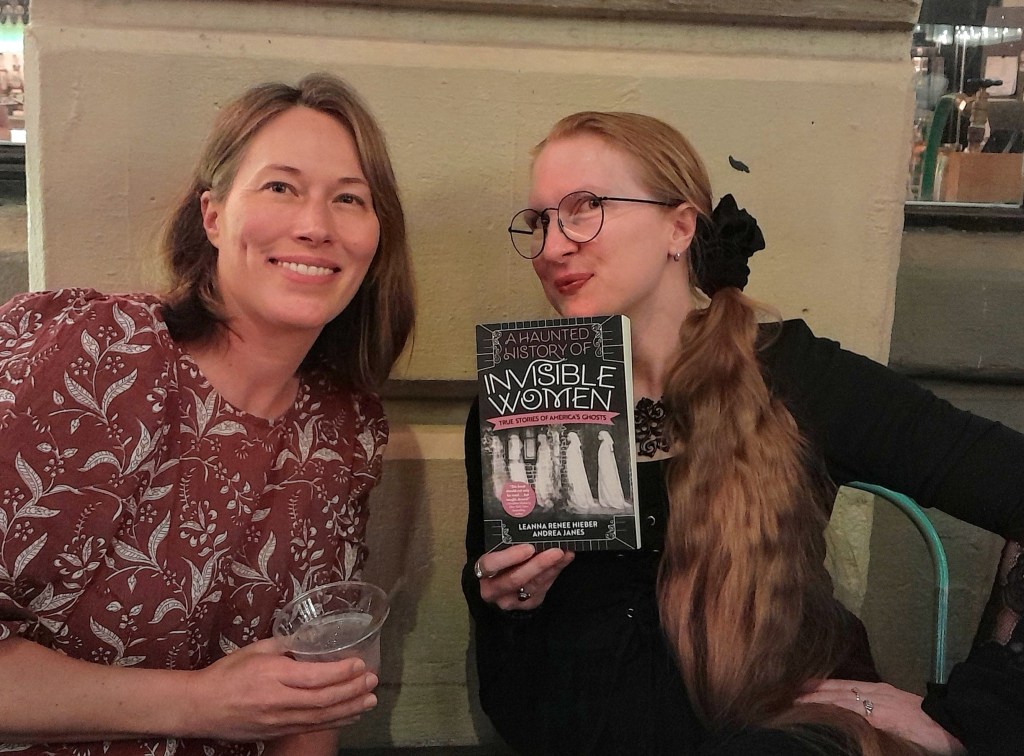
Leanna Renee Hieber is one of the most interesting, knowledgeable, and engaging authors I’ve had the pleasure of getting to know during my time in the book community. Her excitement for the telling of stories that are dear to her is absolutely contagious. With the recent publishing milestone of Leanna’s Bram Stoker Award nominated A Haunted History of Invisible Women: True Stories of America’s Ghosts, I thought it would be nice to chat about the creation of that book, and learn a bit about her upcoming America’s Most Gothic: Haunted History Stranger Than Fiction.


Q: I’ve known you in the bookish community for quite some time and know this is a topic that has always been near and dear to you. What made 2022 the time to write this particular story?
A: Honestly, it was my ongoing work as a ghost tour guide that actually forced the issue in a wonderful way. An editor familiar with my fiction took one of my ghost tours with Boroughs of the Dead, NYCs top ghost tour company, founded by my co-author and decade-long colleague Andrea Janes. The attending editor suggested an expansion into non-fiction, considering my (and Andrea’s) love of the source material and intersections of real history and paranormal encounters. It was one of the most significant suggestions of my life, as now I can’t imagine not working passionately in both fiction and non-fiction for as long as the world will let me tell ghost stories!
Q: You’ve often talked about your own paranormal experiences. Have you had any personal experiences with any of the ghosts highlighted in this book?
A: Many! There’s a really visceral sequence of experiences I discuss in my “Unreliable Narrator” chapter about an infamous Greenwich Village address that has physically made me ill when I’ve been near it. Weird parallels happened in my life while I was first researching it and all the stories about it remain under my skin. On a more positive note, a favorite encounter was a fond touch, a ghostly grab on my elbow I thought was a friend… until I turned and no one was there in the corner of the historic parlor. I’d just exclaimed to a tour group how grateful I was that the Merchant’s House was saved from auction and demolition when the ice-cold, ghostly hand grabbed my elbow; as if the spirits were glad I cared about their house as much as they still haunted it. In nearly all of my chapters, I either share my direct experiences, emotions and encounters or I explain why the story has personal resonance to me, one way or another.
Q: What specific research did you do while preparing to tell these particular stories? Did you already know many of the details, or did you learn a lot of new information?
A: Andrea and I included several New York City ghost stories and women’s histories we knew very well, but when Kensington asked us to expand our exploration around the country, we turned to countless regional accounts, little books full of hyper-regional tales, personal accounts from historical societies, from the famous to the nearly forgotten. We cast a wide net, thumbing through stacks and stacks of books to see what floated to the surface and caught our eye and heart. This book isn’t an encyclopedia or compendium, it’s a carefully curated set of tales that we became the most passionate about, working at first on instinct, then diving deeper and seeing what really had heft to explore further. The whole process took over two years to compile, draft and edit, and 3/4ths of it was entirely new information for us both.
Q: What was the most surprising thing you discovered while researching the book?
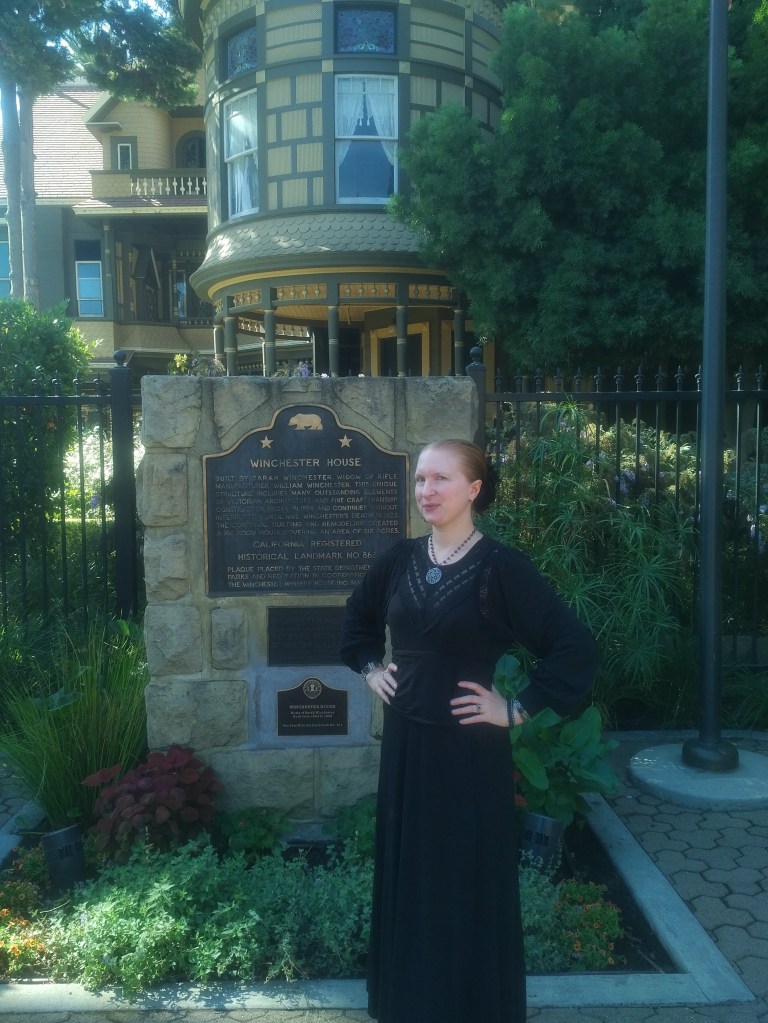
A: The seemingly endless depth of interest and care for Sarah Winchester I developed while researching and writing. I made a comprehensive pilgrimage to the Winchester Mystery House where the house historian there graciously took a long time with me, sharing details not always on the tours, specificity that enriched my experience and understanding. My “Unfinished Business” chapter on Sarah Winchester and her incredible mansion is the longest of my chapters and I think my love of the subject matter particularly shines through. I went to Sarah’s grave in New Haven, Connecticut, to pay my respects and ask for a bit of spiritual guidance. I hope she’s pleased with what I wrote; trying to honor her history while still allowing her to remain the shy, private person she always was, respecting her enough to let the chapter hang open with a bit of unsolved, divine mystery.
Q: Did you find that the women you feature in the book have anything in particular in common — either in life, or as a ghostly presence?
A: The actual women we write about are all unique and interesting people, in and of themselves, separate from their ghost stories. That’s, for us, the most important thing; these were people, not constructs. Women’s experiences are wide and diverse, no woman is a monolith and we really tried to make sure we were representing a range of personalities, histories, fates and legacies. From the tragic to the humorous, from loving to wicked, women can be anything and everything in their own right, and what’s perhaps the unifying theme is that they all have something to say to this day and each has something they can teach the living.
Q: What is the overall feeling or understanding you hope readers have after finishing “A Haunted History of Invisible Women: True Stories of America’s Ghosts“?
A: The book has been out for two years now but people are still finding it every day and diving into the contents with eager interest. We’re so grateful that this book has remained a fresh and vibrant title. Our book is a prompt; bidding the reader to think about how narratives are constructed, to think about their own histories and how they might be written, to remember that a ghost story is an echo of someone who once existed in life rather than a vehicle for cheap thrills. We owe ghost stories depth, nuance and humanity. It doesn’t mean we whitewash evil or erase wrongdoing, but it does mean we’re not interested in exploiting pain or trauma for the purposes of storytelling, we wish to honor difficult history by painting it with as much truth, interest and comprehensive engagement as possible, and we hope that sentiment of a deeper humanity carries to our readership.

Q: You’re currently working on “America’s Most Gothic: Haunted History Stranger Than Fiction“, a similarly presented book focused on infamous gothic occurrences. What can readers expect to learn from that book?
A: A Haunted History of Invisible Women breaks women’s ghost stories down into sections; sorting ghost stories into tropes and stereotypes foisted upon women. In America’s Most Gothic, we’ve selected wild and weird stories from around the nation that fit into Gothic literary tropes and stereotypes. The framework of Gothic storytelling that each of these real histories aligns with gives each story extra staying-power and additional reach, because the tales fit what we might expect out of a haunted narrative. But we won’t stop there. We’ll share how some of these stories utterly defy convention and belief. That’s my favorite part. When I was discussing one of the chapters I’ve been drafting with friends, they assumed a story about a literal corpse-bride was for my fiction. Clarifying that it was in fact a true story for America’s Most Gothic, my friends’ startled surprise was a taste of what I hope we can accomplish with this book.

Retailer Buy Links for A Haunted History of Invisible Women: True Stories of America’s Ghosts
Pre-Order Links for America’s Most Gothic: Haunted History Stranger Than Fiction
Question for readers:
Have YOU ever had a paranormal experience? Have you been to places that have a history of paranormal occurances? Do you have any places that you’d LIKE to go to attempt to have a ghostly encounter?
 Funk-N-Fiction